
Investing in Shares
David Weusten | Wed Mar 25 2026

Investing in Shares
A Client Guide (New Zealand)
What is Share Investing?
Shares represent ownership in a company. When you invest in shares, you are buying a small portion of
that business and participating in its success.
You invest → Company grows and is profitable → Share price increases
↓
Dividends received
Total Return = Capital Growth + Dividends
A Brief History
- 1600s: Dutch East India Company issues the first publicly traded shares
- 1611: Amsterdam Stock Exchange established (first formal exchange)
- 1700s: London Stock Exchange emerges as a major centre for global trade and finance
- 1792: Buttonwood Agreement forms the foundation of the New York Stock Exchange (NYSE)
- 1800s: Rapid expansion of equity markets alongside industrialisation across the UK, USA, and Europe
- Late 1800s: German exchanges (e.g. Frankfurt) grow as industrial capital markets develop
- 1866: New Zealand’s first exchange opens in Dunedin during the gold rush era
- 1900s: Globalisation of capital markets and rise of institutional investors
- Modern era: Highly connected global markets with electronic trading and access to international investments.
Today, investors can access companies across multiple regions including the US (NYSE/NASDAQ), UK (LSE), Europe (e.g. Frankfurt), and New Zealand (NZX), enabling global diversification.
How You Earn Returns
1. Capital Growth
Increase in the value of your investment over time.
Buy at $5 → Value grows to $8 → Gain = $3 per share
2. Dividends
Regular income paid from company profits.
Company Profit → Dividend Paid → Income to You
In New Zealand, dividends may include imputation credits, which can improve after-tax returns.
Risk vs Return
All investments involve trade-offs between risk and return:

Shares tend to offer higher long-term returns, but with short-term volatility.
Key Risks to Understand
- Market ups and downs
- Company-specific performance
- Economic factors (inflation, interest rates)
Short-term volatility ≠ Long-term loss (if well diversified)
Diversification (Reducing Risk)
Spreading your investments helps reduce risk.

Common diversification options: - NZX-listed companies - International shares - Exchange Traded Funds.
Investment Timeframe
Shares are best suited for long-term investing.
Time in the market > Timing the market
Suggested horizon: - Minimum: 5 years - Ideal: 7–10+ years
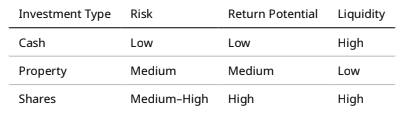
Shares vs Other Investments
Getting Started
- Choose an investment platform (e.g., Sharesies, Hatch, ASB Securities)
- Set your investment goals
- Build a diversified portfolio
- Invest regularly
- Review periodically
Investment Philosophy
Quality, Quality, Quality
Much like the property mantra of location, location, location, a successful share investment approach often centres on buying high-quality businesses.
This typically includes companies with: - Strong and consistent earnings - Competitive advantages ("economic moats") - Proven management teams - Sustainable business models
Focusing on quality can help improve long-term outcomes and reduce exposure to unnecessary risk.
Additional valuation considerations: - Price-to-Earnings (P/E): Be cautious of paying above ~20x earnings, as this may indicate the company is already fully valued or expensive relative to its growth prospects - Net Tangible Assets (NTA): Should be reasonable relative to the company’s industry and asset base - Dividend Yield: Targeting ~8% p.a. or higher can provide a strong income component to total return
Key Takeaways
- Shares are a powerful long-term wealth-building tool
- Returns come from growth + income
- Diversification reduces risk
- Patience and consistency are critical
Next Steps
If you would like personalised advice tailored to your financial goals, risk tolerance, and timeframe, please get in touch.
We can help you build a structured investment plan aligned with your long-term objectives.
This document is for general information purposes only and does not constitute personalised financial advice.
 Buying a Home in New Zealand